


All healthy relationships include doses of conflict. The trick to maintaining a strong relationship isn’t to avoid conflict but to manage conflict discussions constructively, resolve your relationship issues with the help of the “Gottman 4 horsemen,” and bring you and your partner together rather than pull you apart.
If your relationship feels like every conversation ends in a fight, or one of you has shut down completely, you’re not alone. Research by Drs. John and Julie Gottman identified four specific communication patterns that predict relationship breakdown with over 90% accuracy, and more importantly, what to do about each one.
Key takeaways:
-
The “Gottman 4 Horsemen” can predict relationship failure with over 90% accuracy
-
The 4 relationship behaviours that destroy relationships are criticism, defensiveness, stonewalling, and contempt
-
Recognising the Gottman 4 horsemen and avoiding them in your relationship can save your relationship from divorce or separation

Drs. John and Julie Gottman, of the Gottman Institute, created The 4 Horsemen of the Apocalypse, a metaphor referencing the end of the New Testament, used to help you recognise and navigate 4 pitfalls of combative conversations. Instead of having negative communication styles, they aim to help you develop constructive communication patterns.
The Gottman 4 Horsemen of the Apocalypse
The Gottman 4 Horsemen are criticism, contempt, defensiveness, and stonewalling. Gottman’s research has shown, with over 90% accuracy, that these behaviours are a highly accurate predictor of divorce. Therefore, it’s important to be aware of them and apply their solutions.
Each of the Four Horsemen has a solution when used in place of its horseman, which helps you and your partner build your relationship up instead of tearing it down.
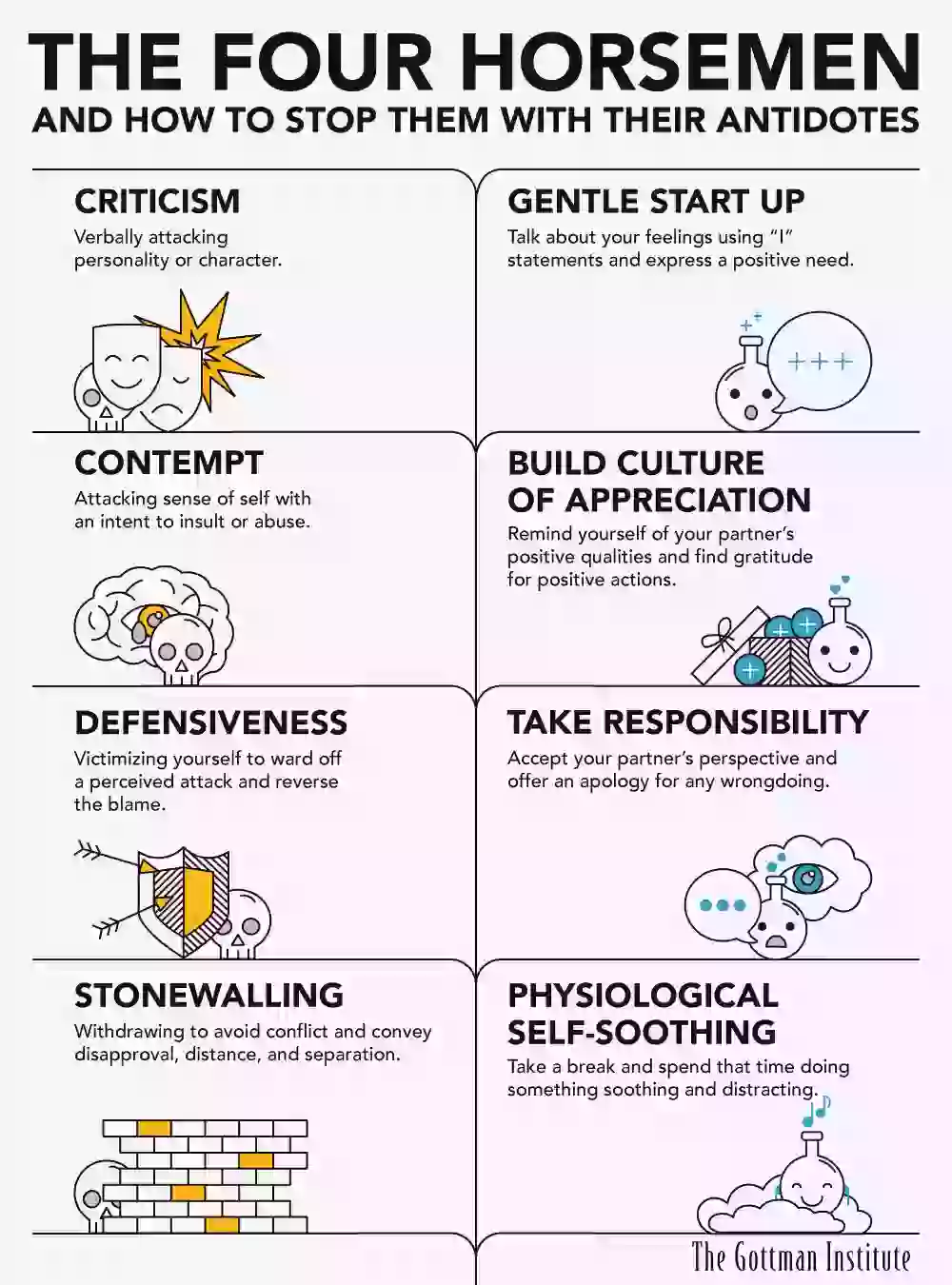
Image: Gottman Institute
Horseman #1: Criticism
The first horseman is criticism, when your comments attack your partner’s personality or character instead of complaining about a behaviour. These comments and name-calling are basically implying that there’s something wrong with him or her, and they can make your partner feel attacked, rejected, and hurt.
Sometimes a perceived attack is not intended but can be triggered by your non-verbal behaviour such as eye-rolling and sighing.
John Gottman calls criticism the gateway horseman because it opens your partner up to be vulnerable to the other 3 horsemen.
Solution: Use a gentle startup
To counteract criticism, talk about your feelings using “I statements.” This approach focuses the conversation on your needs rather than your partner’s faults. Express a constructive need and give your partner the opportunity to meet it.
Example:
Criticism: “You’re so inconsiderate!”
“I” statement: “I need a quiet space to complete this task. I would appreciate it if you would listen to your music on your headphones for a little bit.”
Horseman #2: Defensiveness
Defensiveness occurs when you’re feeling attacked by your partner, and you get angry and focus on self-protection by painting yourself as an innocent victim.
It can occur when you hear your partner’s complaint, react as the innocent victim with righteous indignation, and then blame your partner. Neither one of you is accepting any responsibility for the circumstances.
Solution: Taking responsibility for your feelings
To counteract defensiveness, take the higher ground and accept responsibility for your part in the conflict, even if it’s only a small portion. If you both take responsibility for your feelings, the conflict becomes about solving the problem together rather than fighting each other.
Example:
Defensiveness: “I am not talking too loud!”
Responsibility: “I’m sorry. I could have come closer to talk instead of shouting from the other side of the room.”
Another important part of Gottman’s research discovered that the magic ratio of positive to negative interactions is 5:1. You need 5 positive interactions to counteract every 1 negative interaction. This ratio helps ensure you’re making regular deposits into your emotional bank account.
Horseman#3: Stonewalling
Stonewalling is when you withdraw from a conversation and refuse to engage anymore. The objective of the silent treatment is to avoid conflict and create a sense of distance and separation, but it seldom works. Stonewalling happens gradually after the other horsemen are already active in your relationship.
Stonewalling is a common response to emotional flooding during a conflict discussion. When you get emotionally overwhelmed, stress hormones are released as a physiological response to escalating tension with your partner.
Solution: Practice physiological self-soothing
To counteract stonewalling, take a time-out. Step away from the conversation for at least 20 minutes and focus on self-soothing activities.
Self-soothing, such as listening to music, stretching your muscles, or taking a shower, can make you feel calmer and more relaxed, putting you in a better headspace to re-engage and address the conflict.
Example:
Stonewalling: “Just forget it.”
Self-soothing: “I need to take a break from this conversation. I’m going to go and do [soothing activity], let’s check in again at [time].”
Horseman #4: Contempt
Of all the horsemen, contempt is the most devastating to relationships.
Contempt is the feeling of superiority with which you regard your partner as mean, vile, or worthless. When you act with contempt, you attack your partner’s sense of self, intending to insult or abuse, sometimes from a place of disgust.
This disregard often grows from longstanding negative thoughts about a partner and is the single greatest predictor of divorce.
Solution: Build a culture of appreciation
To counteract contempt, treat one another with respect. You don’t want to make your partner feel inferior. Think of your partner’s positive qualities and express gratitude for positive acts. This takes time, but it’s important to remember that appreciation breeds positive feelings toward your partner instead of festering negativity.
Example:
Contempt: “You’re so stupid, what an idiot!”
Appreciation: “Thanks for trying. I appreciate your help.”
Watch Dr. John Gottman discuss the 4 horsemen in relationships below as he shows some real-life examples.
One indicator of your strength as a couple is your friendship and how well you know each other. Click the button below to take my quiz to find out how well you know your partner.
How many horsemen does it take to damage a relationship?
Most couples will recognise at least one or two of these patterns in their relationship – that’s normal. The concern is when multiple horsemen appear regularly, particularly contempt. Gottman’s research found that contempt alone is the single strongest predictor of relationship breakdown.
If you recognise three or four of these patterns showing up consistently in your conflicts, it’s worth taking seriously. The good news is that these patterns are learned behaviours, which means they can be unlearned with the right support.
What does it mean if we can’t stop the horsemen on our own?
Knowing about the four horsemen and actually changing entrenched patterns are two different things. Many couples read about these concepts and genuinely try to apply them, but find that under stress, they fall back into the same cycles.
This is where couples counselling can help. Working with a therapist trained in the Gottman Method means you have someone in the room who can spot these patterns in real time, interrupt them, and help you practise the antidotes together — not just in theory but in the actual moment of conflict.
If you’re concerned that the 4 Horsemen are impacting your relationship, you can take the Gottman Institute Couple Check-up. It’s a tool that evaluates your relationship’s strengths and challenges and can be completed with a qualified relationship counsellor. Many couples find this tool incredibly helpful in getting a baseline reading of their relationship strengths and challenges.
I use the Gottman Couple Checkup with many of the couples I work with, as it gives a great baseline report of your strengths and vulnerabilities in your relationship.
Recognising the four horsemen in your relationship?
If these patterns feel familiar, couples counselling can help you break the cycle. I’m trained in the Gottman Method and have spent over 20 years helping couples in Ballina and online across Australia rebuild their communication from the ground up.
Book a free 15-minute inquiry call to talk about where to start. No obligation, just a conversation.
This post was updated in March 2026.

Since 2003, Clinton Power has helped thousands of couples and individuals as a counsellor and psychotherapist in private practice in Sydney and online in Australia. Clinton regularly comments in the media on issues of relationships and has appeared on Channel 7, The Sydney Morning Herald, and ABC Radio. Clinton’s eBook, 31 Days to Build a Better Relationship is available to download for free.