


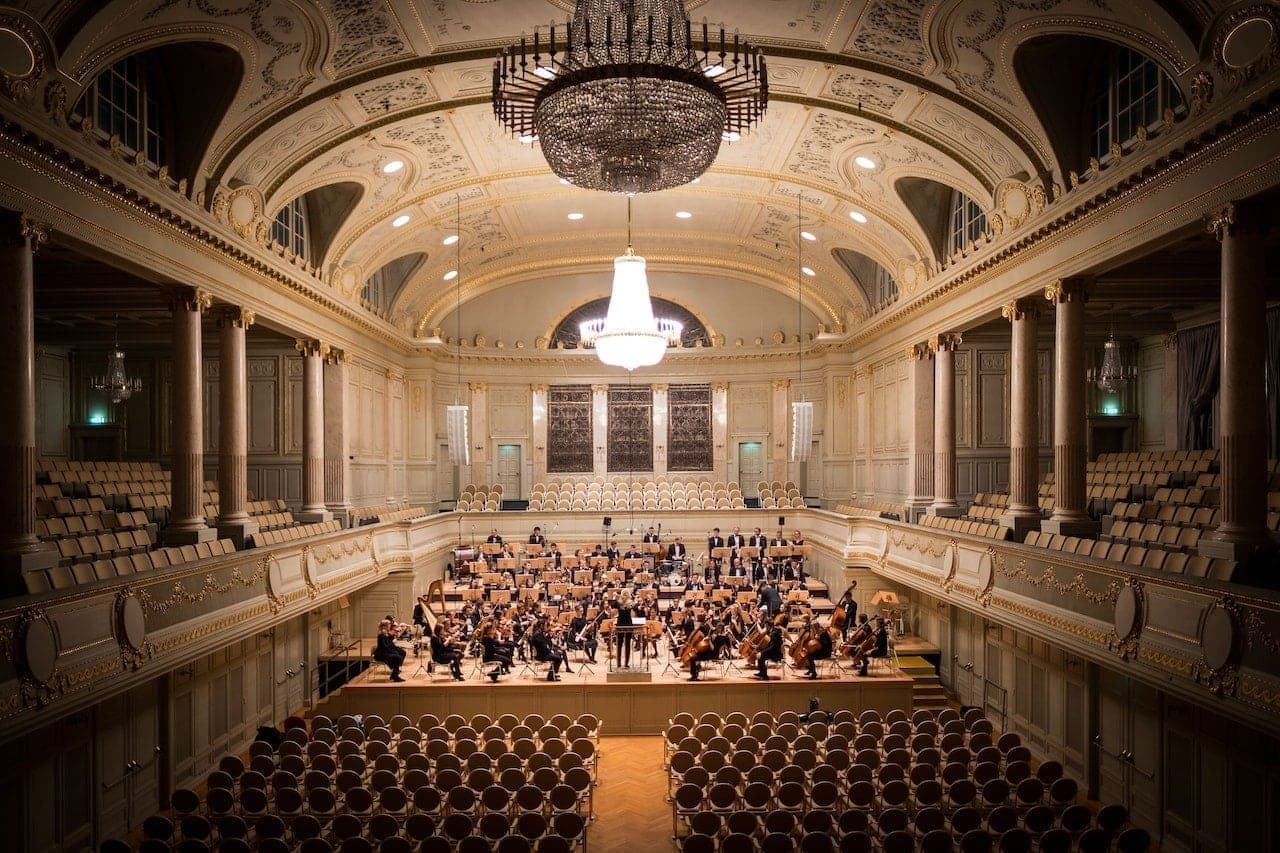
Classical music and relationships have a lot in common.
Believe it or not, I was a classical musician for close to 20 years before I became a full-time relationship counsellor.
I was a trumpet player and performed opera and symphonic music with Australian and international orchestras and managed to see a lot of the world on musical tours.
It was an exciting career, full of great performances, high stress and anxiety, enormous highs and sometimes big lows, but mostly it was enormously rewarding to make music with fine musicians every day of the week.
While I no longer perform, it got me thinking that there are a lot of parallels between being a musician and what’s required to create a successful relationship. Here’s what I think classical music and creating a successful relationship have in common.
They both involve listening
The foundation of being a great musician is listening. When I was playing in the symphony orchestra, I had to listen with every cell in my body. I was listening for other sections of the music, listening for the quality and volume of the sound and then listening to my own sound and constantly adjusting and modifying it to create an overall beautiful quality of sound.
Now in relationships, listening is vastly underrated and almost always under-utilised. Most people just listen in the half-baked way where you are formulating what to say while the other person is speaking. This is the I’m-waiting-to-speak approach as opposed to I’m-listening-reflecting-and-absorbing what you are saying. The question to ask yourself is: Are you truly listening or just waiting to speak?
Relationship Tip: When you work on improving your listening in any relationship, you’ll immediately begin to reap the rewards. The other person feels heard, validated, and acknowledged. What’s more, they will likely be even more interested in your perspective once they feel heard.
They both involve getting in tune
An essential part of being a musician, but even more so for a classical musician is the skill of playing in tune. A large part of my profession was about improving my intonation so that I could play in tune with myself and then match the pitch of other musicians I was playing with. It involved developing a finely nuanced ability to listen to my sound and then match it to the sound of others.
Now there is a nice metaphor here for relationships. An essential skill that all people need to develop in a relationship is the ability to connect and ‘tune in’ to our partners. Another word for this is attunement. If you are not sure what attunement is, watch a mother spending some quiet time with her newborn child. This attunement between mother and child is a necessity for the health and growth of the baby. It also applies to relationships that flourish.
Relationship Tip: The more you ‘tune in’ to your own wants and needs, as well as your partner’s, you are on track for creating an extraordinary relationship.
They both require teamwork
Playing in a symphony orchestra taught me about teamwork. I had to always be in sync with my colleagues, not only in the brass section where I played but right across the orchestra. If I had an exposed entry, I had to connect and work in tandem with the other instruments I was playing with. This often required verbal and non-verbal communication about how best to do this, and at times it wasn’t easy.
In a successful relationship, you need to work as a team. The more you can communicate about your wants, needs and desires, the greater the chance you have of having them met. Remember, your partner is not a mindreader. So many couples I see expect that their partner should know what’s important to them. What’s more, when you are working as a team, you can more flexibly give and take in the relationship.
Relationship Tip: Spend time together and communicate about what’s important to you, your wants, needs, and desires, so that your partner doesn’t have to guess. This then frees you both up to support each other in times of stress.
They both need to start with the end in mind
Another essential element of being a classical music performer was being able to start with the end in mind. This was about creating a vision for the performance; a positive aural formulation of what the performance would sound like. I learned the hard way when I negatively focused on all the things that could possibly go wrong in a performance. And they usually did.
The same applies to creating a successful relationship. You need to create a relationship vision together. This is a picture of the type of relationship you aspire to and want to create together. It includes your values, dreams, hopes and aspirations for the future. It’s like having a map of the future.
We all know when we have a map it’s more likely we will get to our destination. And in the words of my ‘Divorce Busting’ colleague Michele Weiner-Davis, “When you aim at nothing, you hit it 100% of the time.”
Relationship Tip: Think about the type of relationship you want to create together. Each make a list of positive statements about the relationship you aspire to have. Then compare your lists and decide which ones you agree on. This then becomes your relationship vision.
They both require hard work
Now I can assure you I didn’t become a professional musician overnight. I spent years and years of practicing on my own for hours a day. The old adage “you’re only as good as your last performance” was especially true, and always a motivator for practicing consistently over long periods of time. But of course, the rewards were great. There was nothing as euphoric as completing a successful performance and experiencing the gratitude of a concert hall applauding all our hard work.
If there was one myth I wish I could dispel, it would be the myth that “A successful relationship should be easy.” Successful relationships are not easy. They take time, hard work, commitment and your investment of emotional energy. However, like being a classical musician, the rewards are great. Those that put in the hard work, they can appreciate all the wonderful benefits of being in a relationship where each partner is equally invested in themselves and the relationship.
Relationship Tip: Spend time with your partner, commit to communicating about any issues between you, and regularly check in with how you are both doing. Remember, like most things in life, you get back what you put in.
Do you need relationship help?
If you need help with your relationship, contact Clinton Power + Associates on (02) 8968 9323 or book online to discuss your situation and find out how we can help.

Since 2003, Clinton Power has helped thousands of couples and individuals as a counsellor and psychotherapist in private practice in Sydney and online in Australia. Clinton regularly comments in the media on issues of relationships and has appeared on Channel 7, The Sydney Morning Herald, and ABC Radio. Clinton’s eBook, 31 Days to Build a Better Relationship is available to download for free.
Clinton,
Brilliant post. i absolutely LOVE this metaphor, the connection between classical music and relationships.
Thanks so much for sharing it,
Adam
Thanks so much for your feedback Dr. Sheck. I appreciate your input.
I enjoyed reading the article!
I also use metaphor in my clinical practice. Still, I had not heard about this parallel before.
Thanks for the inspiration!
Stavroula (a colleague from Greece http://psypath.blogspot.com/)
Thanks for your feedback Stavroula. Working with metaphors can be a powerful way of connecting with your clients.
Once upon a time, I was a classical musician. Now I’m in a marriage and we have the occasional communication problem. This article has really ‘resonated’ with me, really ‘struck a chord’ *chuckle*. In retrospect, I don’t listen as much as I thought I did. I’m going to attempt to listen and tune as accurately with my partner as I did behind a cello. Thanks for the insight!
Thanks for your comments Evalyn. If more of us could tune into our partners words, tone and meaning, many of us would immediately experience an improvement in our relationships. I think the challenge is to hold back our own reactions and responses while we focus on the ‘other’. Not always an easy task!